
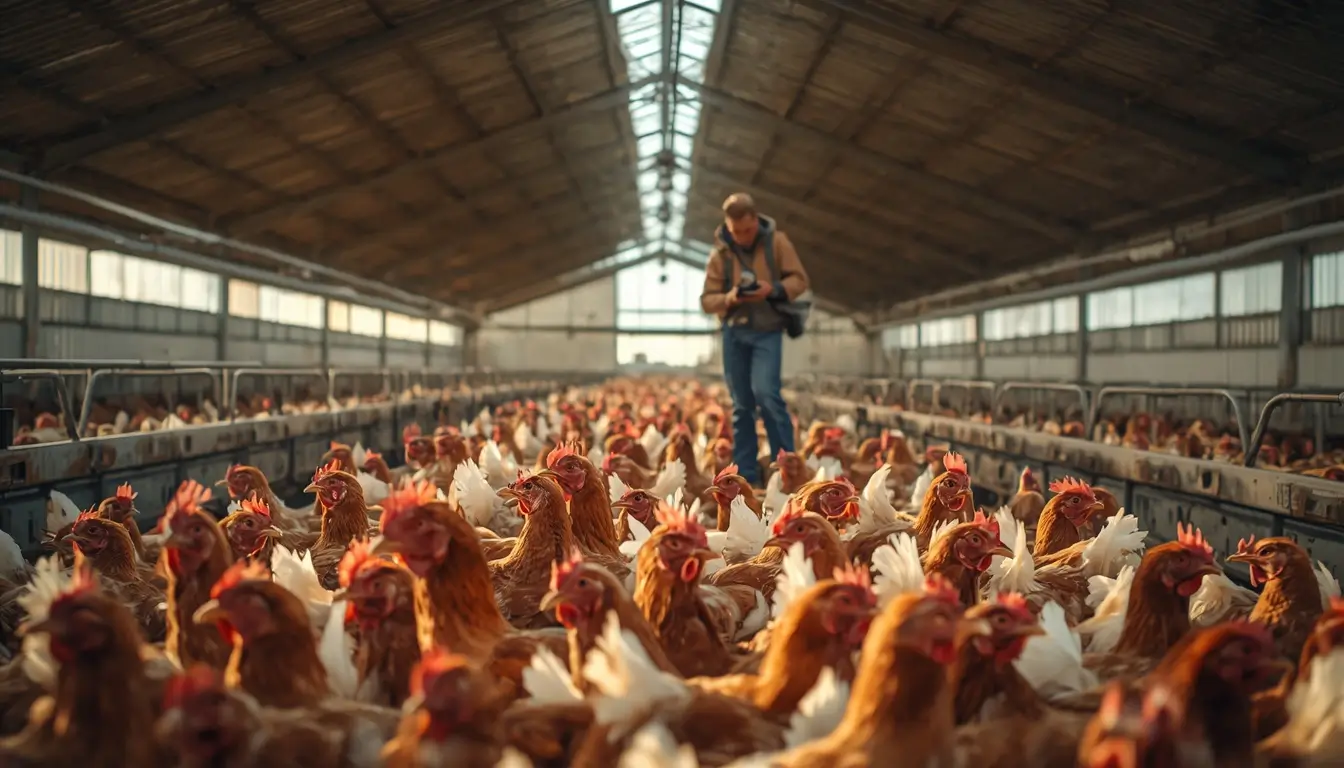
Poultry farming can be profitable, but actual returns vary widely by production system, feed costs, mortality, selling prices, labor, and scale. It's a business where small mistakes cost real money fast and where the difference between a good year and a bad one often comes down to a couple of percentage points in feed conversion.
Is Poultry Farming Profitable?
Poultry profit margins vary widely by farm type and location. Gross margin is calculated before some fixed and overhead costs, while net profit accounts for a much broader set of expenses. Feed prices, mortality, labor, housing, financing, and selling prices can all materially change the final result. The honest answer is that poultry farming can be profitable, but it requires tight cost control and careful planning rather than guesswork. Small changes in mortality and feed conversion can materially change the profitability of a poultry cycle because feed is one of the largest production costs. That's the reality beginners underestimate the most.
How Does Poultry Farming Make Money?
Poultry farms earn revenue from a few main channels: meat sales (broilers), egg sales (layers), chick and pullet sales, manure, and, in some regions, litter. Broilers are generally sold after several weeks of growth, depending on target weight and market. Layer farms sell eggs daily or weekly, giving a steadier cash flow than broilers, which pay out in lump sums at the end of each cycle.
Profit is what's left after feed, chicks or day-old birds, labor, utilities, housing costs, medication, and mortality losses are subtracted from that revenue. Feed is usually the largest recurring expense on a poultry farm and can represent a large share of total production costs. That single number explains most of what separates a profitable farm from a struggling one. Improving feed conversion can have a major effect on your margin, especially when feed is one of your largest production costs.
How Much Profit Can a Poultry Farm Make?
It depends heavily on scale and system, but here's a realistic range across farm types:
A study of broiler farmers in Nigeria found a percentage profit margin of roughly 45.6%, though that figure reflects gross margin against variable costs rather than a fully loaded net figure. On the other end, a Ghanaian case study of 200 broilers found a net margin closer to 11% after all operating costs. The difference between those figures shows why profitability numbers should be compared using the same definition of margin and similar production assumptions.
Poultry Farm Income Per Month
Monthly income scales with flock size and system. U.S. contract broiler growers typically receive payments for raising birds under an agreement with an integrator. The grower generally provides the housing, equipment, utilities, and labor, while the integrator supplies inputs such as chicks and feed. The amount a grower actually retains depends heavily on housing costs, debt, operating expenses, and contract performance.
In India, a 1,000-bird layer flock can produce up to 25,000 eggs a month, generating roughly ₹1.25 to ₹1.5 lakh in monthly revenue. At 10,000 birds, monthly net profit commonly falls between ₹2.5 and ₹4.5 lakh depending on housing type and management quality. In Kenya, a well-run flock of a few hundred kienyeji or layer birds can generate a net profit in the range of KSh 30,000 a month once the flock reaches full production, though startup and ramp-up months typically run at a loss or break-even.
Cash flow depends on the production system. Broiler farms typically receive revenue when birds are sold, while layer farms generate recurring egg revenue once the flock reaches production. The first cycle or two rarely turns a strong profit because you're absorbing setup costs and mortality while learning the operation.
Which Type of Poultry Farming Is Most Profitable?
Layer farming can provide more consistent cash flow because eggs are sold regularly, while broiler farming generates revenue at the end of each production cycle. Which system is more profitable depends on local feed costs, selling prices, production efficiency, and startup costs.
Free-range and pasture-based poultry can command higher selling prices in some markets, but higher prices do not automatically mean higher profits because these systems may also involve higher labor, land, feed, processing, and certification costs.
Is Layer Poultry Farming Profitable?
Yes, layer farming is generally more profitable per bird than broiler farming, mainly because of the steady cash flow. In India, layer operations generate average net returns of roughly ₹6 to ₹8 profit per egg, and a 10,000-bird cage system can produce ₹3 to ₹4.5 lakh in monthly net profit. The tradeoff is higher upfront capital and a longer runway before birds start laying, typically 18 to 22 weeks, so you need enough working capital to cover feed costs before any egg revenue arrives.
Is Contract Poultry Farming Profitable?
Contract poultry farming can be profitable, but it's a lower-risk, lower-ceiling model compared to independent farming. Under the tournament pay system used by most US integrators, growers are paid per pound of live weight delivered, with a base rate that has historically hovered around six cents per pound, adjusted up or down based on how your flock performed relative to other growers in the same batch period. That means your pay depends partly on factors outside your control, like the performance of neighboring farms.
The integrator supplies chicks, feed, and medication, which removes most of the market risk, but the grower still finances the housing, which is the largest capital cost in the entire operation. A standard 20,000-square-foot broiler house runs $300,000 to $600,000 to build, financed over 15 to 20 years. Contract farming works best as a stable, debt-service-covering income stream rather than a fast path to wealth, and new housing bonus programs from some integrators can meaningfully change the math for the first several years of a contract.
Is Poultry Farming Profitable for Beginners?
Poultry farming is one of the more accessible agribusinesses for beginners because it needs relatively little land, produces income within weeks rather than seasons, and scales up gradually. Startup costs for a small US operation run roughly $5,000 to $30,000 depending on scale and housing, and in developing markets, a small flock of 100 to 200 birds can start with even less capital.
That accessibility is also the trap. Because the barrier to entry is low, a lot of beginners underestimate feed costs, skip proper vaccination schedules, or overcrowd housing, and those mistakes show up directly in mortality and feed conversion. Farmers who don't calculate full lifecycle costs before starting a batch commonly underestimate total expenditure by 15% to 25%, which is often the exact gap between profit and loss on a first cycle.
Start small. A flock of 100 to 500 birds is enough to learn feeding schedules, disease management, and your local market before you scale into serious capital investment.
Poultry Farming Profit Example
Here's a simplified example for a small US-scale operation of 500 broilers over one 8-week cycle:
Day-old chicks (500 @ $1.20 each): $600
Feed (roughly 5.2 kg per bird over the cycle): approximately $1,500 to $1,800
Utilities, bedding, medication: $300 to $500
Labor (part-time/owner-operated): not counted as a hard cost
Total operating cost: roughly $2,400 to $2,900
With 4%–6% mortality, approximately 470–480 birds reach market. At 2.2 kg each and $2.50/kg, gross revenue would be about $2,585–$2,640. Against estimated operating costs of $2,400–$2,900, the cycle could range from a modest loss to a modest operating profit before owner labor, housing depreciation, financing, and other fixed costs.
This is exactly the kind of math worth running before you commit capital. A poultry farming profit calculator lets you plug in your own flock size, feed cost, and expected mortality to see your real numbers instead of relying on someone else's example.

Poultry Farming vs Fish, Pig, Goat, and Crop Farming
Fish farming or poultry farming, which is more profitable? Fish farming can offer higher profit margins per unit, especially for high-value species, but it demands more technical skill, more capital, and a longer grow-out period, often several months to over a year. Poultry gives you faster, more frequent returns and a more predictable, established market. If you need cash flow sooner rather than later, poultry usually wins; if you have the capital and patience, fish farming's ceiling can be higher.
Poultry farming or pig farming, which is more profitable? Pig farming generally has a longer production cycle than broiler poultry (5 to 6 months to market weight versus 6 to 8 weeks), but pigs convert feed efficiently and command consistent meat prices, often producing solid per-animal margins. Poultry wins on speed and lower capital entry; pigs can edge ahead on margin per animal once you're established.
Goat farming or poultry farming, which is more profitable? Goats have lower feed costs since they browse rather than requiring formulated feed for most of their diet, and they carry strong resale and breeding value. But goats take longer to reach profitable herd size, and poultry generates income far sooner. For fast cash flow, poultry is the stronger starting point; for a lower-input, longer-horizon asset, goats compete well.
Poultry farming vs crop farming: Poultry turns over capital much faster than most row crops, which pay out once or twice a year. Crop farming carries more weather risk and slower cash cycles, but generally lower daily management demands. Many successful small farms run both, using poultry for steady cash flow while crops build longer-term land value.
Is Poultry Farming Profitable in Different Countries?
Poultry farming can be profitable in many countries, but the numbers vary significantly by feed prices, bird productivity, mortality, local selling prices, labor, housing costs, and access to markets. A profit figure from one country should not be treated as a universal benchmark for another.
Kenya: Broiler and improved indigenous chicken farming can be profitable when farmers control feed costs, maintain good flock health, and have reliable access to buyers. Indigenous and improved Kienyeji chickens can also receive higher selling prices than standard spent birds in some local markets, particularly when demand increases during holidays and other peak periods. Actual profit depends on production costs and the price farmers receive at sale.
Nigeria: Broiler and layer farming are important smallholder poultry enterprises, but profitability varies between farms and production systems. Feed and chick costs are major expenses, so efficient feeding, good mortality control, and reliable market access can have a significant effect on returns. Published studies may report different gross margins or net incomes depending on flock size, location, and the costs included in the calculation.
India: Poultry farming is widely practiced at both small and commercial scales. Broiler profitability depends mainly on chick prices, feed conversion, mortality, live-bird prices, and the length of the production cycle. Layer farms can provide more regular cash flow because eggs are sold continuously after the flock reaches production. However, profit per bird or per egg can change considerably with local market prices and feed costs.
Pakistan: Broiler and layer farming can be profitable, but margins are highly sensitive to feed prices, chick or pullet costs, disease, mortality, and live-bird or egg prices. Farmers located close to major markets may benefit from lower transportation costs and access to fresh-bird or egg buyers, although local competition and market fluctuations can also affect profitability.
USA: U.S. poultry production includes both independent farms and contract growing arrangements. Contract broiler growers generally provide housing, equipment, utilities, and labor while the integrator supplies major production inputs such as chicks and feed. Grower income depends on the contract structure and production performance, while housing and financing costs can have a major effect on the grower's final return. Independent and pasture-based producers may have opportunities to receive higher selling prices, but they also face additional marketing, processing, labor, land, and production costs.
Other African markets: Poultry farming is also an important small-scale agribusiness in countries such as Ghana, Uganda, Zambia, Tanzania, Zimbabwe, Rwanda, and Ethiopia. However, profitability differs considerably between markets. Feed availability and price, access to chicks, disease management, purchasing power, transportation, and local selling prices can all influence the final return. Rather than using one profit-margin figure for all of these countries, farmers should calculate profitability using their own local costs and selling prices.
The Bottom Line
There is no single poultry profit margin that applies to every country. The same flock size can produce very different results depending on feed costs, mortality, selling price, and operating expenses. For a more realistic estimate, use your actual flock size, expected mortality, feed cost, selling price, and other expenses when calculating potential poultry farm profit.

How to Increase Poultry Farm Profit
1. Track feed conversion ratio every cycle and adjust rations before costs spiral.
2. Vaccinate on schedule. Disease outbreaks are the fastest way to erase a season's profit.
3. Sell direct to consumers or restaurants where possible to capture retail margin instead of wholesale.
4. Diversify income with manure sales, spent hen sales, or hatching eggs.
5. Calculate full lifecycle costs before every batch, not just feed and chicks, so you're not blindsided by a 15% to 25% cost gap partway through.
6. Consider free-range or organic certification if your market supports the 30% to 50% price premium.
Is Poultry Farming a Good Business?
Poultry farming is a good business for people willing to manage it like one: tracking numbers closely, controlling feed costs, and staying ahead of disease risk. It's not a passive investment, and margins are genuinely thin in commercial-scale operations. But it offers fast cash cycles, low land requirements compared to crops or cattle, and a market that never really goes away, since chicken and eggs stay in steady demand across almost every country and income level.If you're weighing whether to start, the smartest first move isn't buying chicks, it's running the numbers for your specific flock size, local feed prices, and expected market rate. That's the difference between a hopeful guess and a real business plan.
FAQs
Is poultry farming profitable for a first-time farmer?
Yes, if you start small (100 to 500 birds), track your costs closely, and don't over-leverage on housing before you've run at least one full cycle. Most losses among beginners come from underestimating feed costs and mortality, not from the business model itself.
How much profit does a small poultry farm make per month?
A small flock of a few hundred layers can generate anywhere from $200 to $1,500+ per month depending on egg prices and local costs, while broiler income arrives in lump sums every 6 to 8 weeks rather than monthly.
Which is more profitable, broiler or layer farming?
Layer farming generally offers steadier, more predictable income because eggs sell daily. Broiler farming can produce a higher return per cycle but carries more exposure to market price swings at the point of sale.
Is contract poultry farming a good way to start?
Contract farming lowers your market risk since the integrator supplies chicks and feed, but you still carry the housing debt, which is the largest cost in the entire operation. It suits people who want stable income over high upside.
Does poultry farming remain profitable at a small scale, like 100 birds?
Yes, though margins per bird are typically thinner at a small scale since fixed costs like housing aren't spread across many units. It's a reasonable way to learn the business before scaling up.
What's the biggest factor that determines poultry farming profit?
Feed cost and feed conversion ratio, hands down. Feed alone typically accounts for 65% to 70% of ongoing costs, so small improvements in efficiency have an outsized effect on your bottom line.