
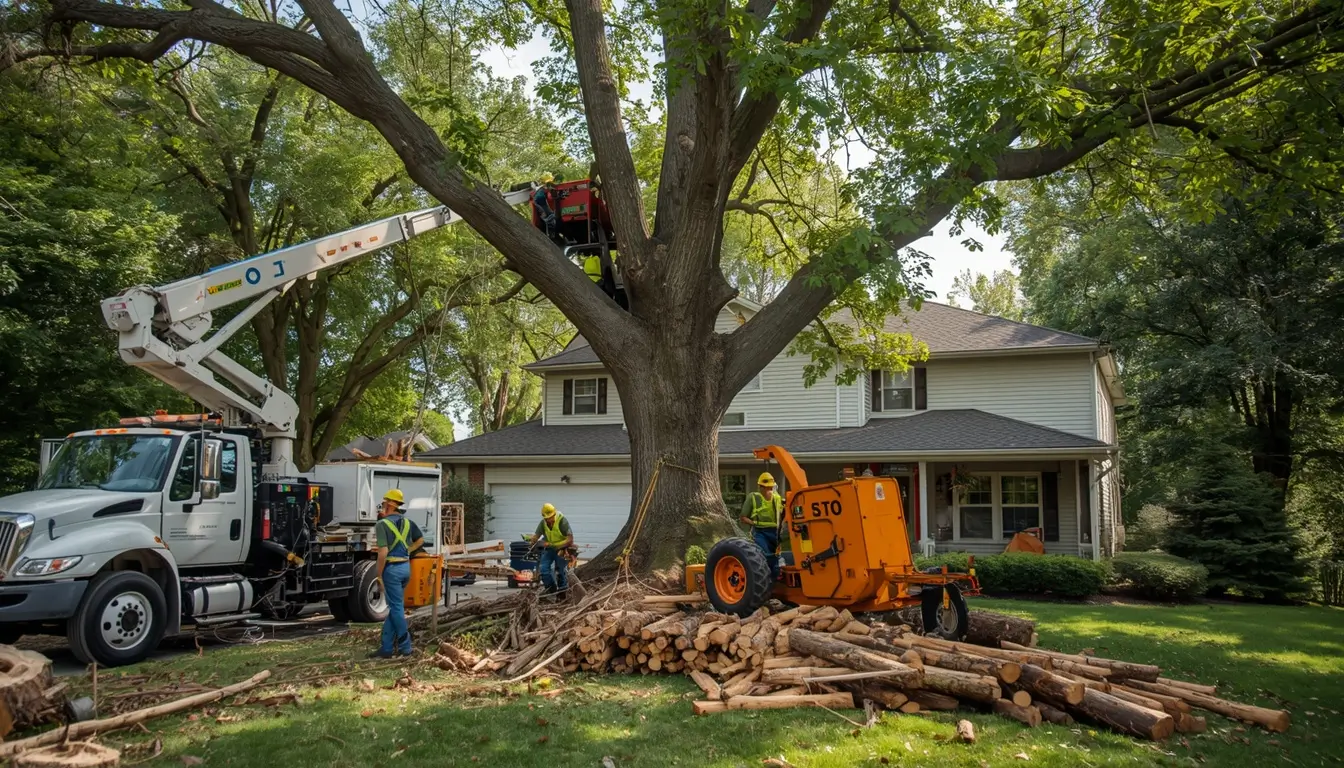
Get three quotes for the same tree and you might see three very different numbers, sometimes hundreds of dollars apart. That's not a sign someone is overcharging you. Tree removal pricing simply works that way: crew size, equipment, and risk all change the math. This tree removal pricing guide walks through exactly what changes the number, so you're not guessing when a quote lands in your inbox.
The short answer: a typical, common tree removal costs $400 to $1,800, with the national average sitting around $750 to $900. That range covers most standard jobs. It's not a hard ceiling. Small trees can run as low as $150, and large or hazardous trees can climb well past $1,800, sometimes reaching $3,000 to $5,000 or more once you factor in size, condition, or emergency timing. This tree removal cost guide breaks pricing down by size, height, species, and location, plus what actually drives your number up or down, so you know roughly what to expect before you ask a tree removal service for a quote.
Here's the pricing hierarchy in one place, so you know where your tree is likely to land before reading further:
Want a quick estimate for your tree? Use our Tree Removal Cost Calculator to estimate the potential cost based on your tree's size, height, and project factors.
How Much Does Tree Removal Cost?
Most tree removals fall between $400 and $1,800, with the typical homeowner paying close to $750 to $900. Think of that as the common-job range: the price you'd expect for a small to medium tree with normal access and no major complications. If you're just trying to figure out the cost to remove a tree from your own yard, start here and adjust based on the size and type sections below.
That range doesn't hold for every job, though. A small, healthy tree with easy access can cost as little as $150, well under the typical range. A large tree, one over 60 feet tall, dead, leaning toward a structure, or tangled in power lines, can push past $1,800 and land anywhere from $2,000 to $3,000. Extreme cases, very large trees combined with emergency timing or serious hazards, can reach $3,000 to $5,000 or more. So $400 to $1,800 is your baseline for a common job, not a ceiling for every tree.
Most tree services quote a flat price after walking the property rather than charging by the hour. For very tall trees, some companies price roughly by the foot, since height is the single biggest driver of labor, rigging, and equipment. Whichever method a company uses, get the number in writing and confirm exactly what it covers before the crew shows up.
Tree Removal Cost by Tree Size
Size is the first thing any tree removal service looks at, and tree removal pricing by size is the quickest way to ballpark your own project.
These ranges assume a healthy tree with normal yard access. A steep slope, a tight side yard, or a trunk over 24 inches wide can push your quote toward the top of the range, or past it. Notice that large and very large trees are exactly where jobs start exceeding the $1,800 typical-job range mentioned earlier. Size is the main reason a removal moves from common-job pricing into large-job pricing.

Tree Removal Cost by Height
Height is one of the biggest factors affecting tree removal price, and it's not only about how far up the crew climbs. Taller trees need heavier rigging, sometimes a bucket truck or crane, and more rope work to lower branches piece by piece instead of letting them drop. That usually means a bigger crew and a longer day, and both show up in your bill. When comparing tree removal pricing by height, use the size table above as your starting point and expect the number to move up as height increases, especially past 60 feet.
A 20-foot ornamental tree usually comes down in under an hour with a chainsaw and two workers. An 80-foot oak has to be taken apart section by section and lowered carefully so nothing lands on the fence or the roof. That's a full day of work for a full crew, and the price reflects it.
Tree Removal Cost by Type
Tree species can affect removal costs because wood density, tree structure, height, and condition can change the equipment, labor, and time required.
Oak sits near the top of this list because its wood is dense and heavy, which slows the cut and wears down equipment faster. Pine is generally cheaper per foot since the wood cuts easily, even though pines can grow very tall. Palms look expensive because of their size, but the trunk is usually lightweight and uniform, so most of the cost comes from height rather than difficulty. Ash and elm often carry a premium too, mainly due to disease risk (emerald ash borer and Dutch elm disease) that can leave the wood brittle and unpredictable.
If you're not sure what species you have, a photo is usually enough for a local tree company to give you a rough range before an in-person visit.
What Affects Tree Removal Cost
Beyond size, height, and species, these tree removal cost factors show up on nearly every quote:
A tree in a tough spot, near a structure or power line, or with no equipment access, can add roughly 25 to 50% to the base price. Accessibility is worth thinking about before you assume a quote seems too high.

Real-World Example
Say you have a 45-foot maple in a suburban backyard. It's healthy, but its roots have grown close to a fence, and there's no truck access from the street, so the crew has to carry debris out by hand. A typical quote might break down like this:
That lands above the $450 to $900 medium-tree range because of the access issue, which is a normal, common adjustment, not a sign of an inflated quote.
Add-On Costs Most Quotes Leave Out
This is where people get caught off guard. The quote looked reasonable, but the final invoice was higher. It's usually one of these:
Before you sign anything, ask four questions: Is debris removal included? Is stump grinding part of this price? Does my area require a permit? Is there a travel fee? A reputable company should answer all four without hesitating.
Fallen Tree Removal Cost
If the tree is already down, the job is usually cheaper, since the riskiest part, cutting a standing tree, is already done. Removing a fallen tree typically costs $90 to $500, depending on its size and how much cutting and hauling it needs. If it fell on your house, car, or fence, this usually shifts into emergency and insurance territory instead of a standard quote.
Tree Stump Removal Cost
Stump removal is almost always billed separately from tree removal. You have two main choices. Stump grinding, where a machine grinds the stump 6 to 12 inches below ground and leaves the roots to break down naturally, costs $150 to $450 and is what most homeowners pick. Full stump and root removal, which digs out the entire root ball, runs $300 to $550 or more, and makes sense if you're planning to build, plant, or landscape over that spot.
Emergency Tree Removal Cost
A tree on your roof during a storm isn't a standard-pricing situation. Emergency tree removal typically runs $1,500 to $5,000, reflecting rush scheduling, after-hours labor, and sometimes utility coordination if power lines are involved. Expect rates to run 25 to 50% higher than the same job booked during normal business hours.
Homeowner's insurance may help cover removal when a tree damages a covered structure, such as your house, garage, or fence, during a storm or other covered event, though coverage depends on your specific policy and provider. If the tree fell in your yard without hitting anything, many standard policies won't pay for removal, so it's worth a quick call to your insurer to confirm what your plan actually covers before you assume either way.
Tree Removal vs. Tree Trimming
Not every problem tree needs to come down. Trimming solves plenty of issues for a fraction of the cost, so it's worth knowing which one your tree actually needs.
A diseased or structurally unsound tree should come down. A healthy tree that's just overgrown or brushing your roofline usually only needs a trim, which is the cheaper call if that's genuinely all it needs.
Regional Price Differences
Where you live changes what you pay, mostly because of local labor costs and how competitive the market is, not the tree itself.
These are general patterns, not guarantees. A busy suburban market can easily price higher than a slower rural one in a different state, so local quotes are still the only real way to know your number.
Do You Need a Permit to Remove a Tree?
Possibly. Many cities and counties require a permit for trees above a certain trunk diameter, often 6 to 10 inches, or for species on a protected or heritage list, though rules vary a lot by location. Permit costs typically run $25 to $500 depending on your jurisdiction. Skipping a required permit can lead to fines in some areas, so it's worth a quick check with your local planning or public works department before scheduling the job, especially for large or older trees.
How to Hire a Legitimate Tree Service (and Red Flags to Avoid)
Shopping on price alone is how homeowners end up with an underinsured crew, unfinished cleanup, or a dispute that costs more than the removal itself. A few habits help protect you.
Get at least three quotes. Prices for the same tree can vary by 50% or more between companies, so one quote alone doesn't tell you much about the fair market rate.
Confirm what's included. Debris removal, stump grinding, and cleanup vary by company, so make sure every quote covers the same scope before you compare numbers.
Ask for proof of insurance. You want to see general liability coverage and workers' compensation. Verifying this matters because if a crew member is hurt on your property and the company carries no workers' comp, you could end up sharing in that liability.
Look for arborist credentials. Companies with an ISA Certified Arborist on staff, a credential from the International Society of Arboriculture, tend to give more consistent assessments. You can also check whether a company is a member of the Tree Care Industry Association (TCIA), which requires member firms to carry liability insurance and follow ANSI safety standards.
Watch for these red flags:
Storm-chasing crews that appear right after bad weather with unusually low prices are also worth being cautious about. Some are legitimate, but others aren't insured or licensed and won't be reachable if something goes wrong later.
DIY vs. Professional Tree Removal
Tree removal is genuinely dangerous work, even for smaller trees, and it's worth taking that seriously before picking up a chainsaw. Falling limbs, unpredictable lean, and kickback are real risks, and a mistake can mean a serious injury or thousands of dollars in property damage in seconds.
If you still want to consider it yourself, DIY removal only makes sense under fairly narrow conditions: the tree is under 20 feet tall, it has a clear, open fall path with nothing nearby to damage, and it isn't dead in a way that makes the wood unpredictable. Basic safety gear, a chainsaw, a hard hat, safety glasses, gloves, and felling wedges typically cost $250 to $425 total, which is close to what a professional charges for the smallest jobs anyway.
Outside those narrow conditions, hire a professional. That means anything taller, anything leaning toward a structure, anything you'd genuinely regret losing, and anything anywhere near power lines. If you have any doubt at all about whether it's a clean, low-risk job, that doubt is your answer: call a professional instead.
How to Get an Accurate Tree Removal Quote
Ask for an in-person estimate instead of a phone quote. A crew needs to see the tree's actual height, lean, trunk diameter, and how close it sits to structures to give you a tree removal estimate that holds up on the day of the job. When comparing quotes, confirm whether stump grinding, debris hauling, and permit fees are included in the tree removal service cost, since those line items are what usually turn a quoted $500 into an $800 bill. Getting two or three estimates before booking remains the simplest way to avoid overpaying, especially on larger jobs.
Final Thoughts
Tree removal cost comes down to a handful of things you can check for yourself before a crew ever shows up: size, height, species, accessibility, and timing. A small, easy-access tree might run you a few hundred dollars. A large or storm-damaged one near your house could run into the thousands. Either way, the best way to protect your budget is the same: get two or three written quotes, confirm exactly what's included, and check that whoever you hire carries proper insurance.
Ready to estimate your costs? Use our Tree Removal Cost Calculator to get a quick estimate before requesting local quotes. It can help you understand what you might pay and give you a useful starting point when comparing contractor estimates.
Frequently Asked Questions
How much does tree removal cost?
Typically $400 to $1,800, with a national average around $750 to $900.
How much does it cost to remove a 20-foot tree?
Roughly $150 to $450, since this falls in the small-tree range.
How much does it cost to remove a 30-foot tree?
Around $250 to $600, near the small-to-medium border.
How much does it cost to remove a 50-foot tree?
Generally $450 to $900, a standard medium-tree job.
How much does it cost to remove a 60-foot tree?
Usually $900 to $2,000, at the lower end of the large-tree range.
How much does it cost to remove an 80-foot tree?
Typically $2,000 to $3,000 or more, at the top of the large range and into very large pricing.
Does tree removal cost include stump removal?
No, it's typically billed separately: $150 to $450 for grinding, or $300 to $550 for full root removal.
How much does emergency tree removal cost?
Usually $1,500 to $5,000, roughly 25 to 50% above standard pricing.
Is tree removal cheaper than trimming?
Usually yes for a single visit, but a tree needing repeat trims every year or two can cost more over time than one removal.
Who pays if a neighbor's tree falls on my property?
Usually the property owner where it lands does, typically through their own homeowner's insurance, though a documented prior hazard on the neighbor's side may change that.
Is tree removal tax deductible?
Rarely for a personal residence. Exceptions can apply for a home office, rental property, or federally declared disaster. Check with a tax professional.
What makes tree removal expensive?
Height, trunk diameter, wood density, condition, and proximity to structures or power lines, plus emergency timing and permit requirements.
Sources
1. Angi, "How Much Does Tree Removal Cost?"
2. HomeAdvisor, "How Much Does Tree Removal Cost?"
3. Angi, "Stump Removal Cost"
4. Angi, "Tree Debris Removal Cost"
5. Tree Care Industry Association (TCIA), "Hiring a Tree Care Company"
6. International Society of Arboriculture (ISA), isa-arbor.com
Pricing figures above reflect a synthesis of current industry cost data as of 2026 and general ranges reported across multiple sources. Actual quotes vary by region, provider, and property conditions, so always confirm pricing directly with a local tree service.